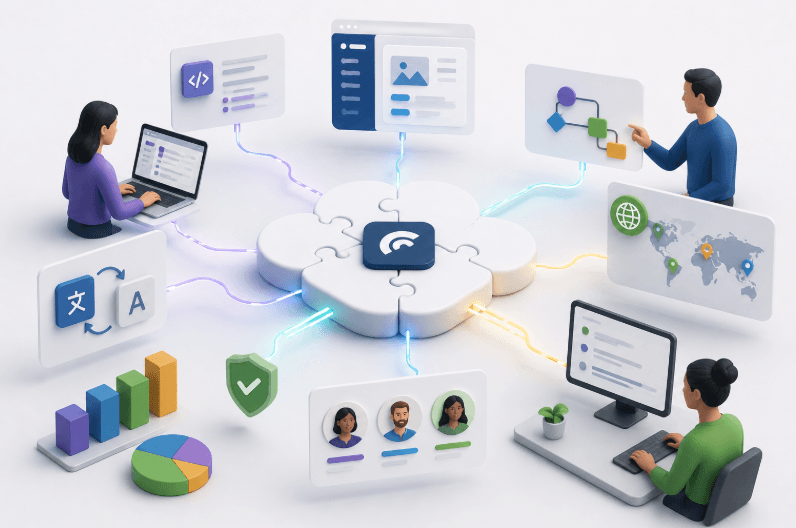
Growth is one of the defining goals of any SaaS business. At first, growth often means adding new features, improving onboarding, refining pricing, and finding stronger acquisition channels. But eventually, growth points outward. It starts to mean entering new markets, serving customers in more languages, and delivering a product experience that feels native no matter where users live. That is the moment when localization stops being a side task and becomes a core operational discipline.
Too many SaaS companies approach localization in a fragmented way. Marketing publishes campaign copy in one system, support teams maintain help articles somewhere else, developers ship interface updates through their own workflow, and translation requests are managed in isolated spreadsheets or ad hoc messages. At a glance, this may seem manageable. In reality, it creates delays, inconsistency, duplicated effort, and a poor experience for users who expect the same level of clarity in every language.
A connected localization workflow solves this problem by linking the systems your company already depends on. Instead of forcing teams to manually move text from one platform to another, it creates a structured flow between your product, help center, development tools, and translation environment. The result is faster updates, fewer content silos, and a more reliable multilingual experience across the entire customer journey.
For SaaS businesses, this is not just an efficiency upgrade. It is a competitive advantage. When your localization workflow is connected, the product experience becomes more coherent, support becomes more useful, and global expansion becomes more sustainable.
Localization Is More Than Translation
Many companies still think localization begins when a string of text is ready to be translated. That view is too narrow for SaaS. In a software business, language touches almost everything: the interface, onboarding flows, release notes, transactional emails, support articles, feature documentation, legal notices, and marketing pages. If these assets evolve separately, the customer feels the disconnect immediately.
Imagine a product team launching a redesigned settings page while the knowledge base still explains the old interface. Or picture a help center article in Spanish referencing a feature name that was updated in the product but never changed in the support content. These small inconsistencies create confusion, increase support tickets, and weaken trust. In SaaS, users do not experience your product as isolated content pieces. They experience one ecosystem.
That is why localization must be treated as an end-to-end workflow, not a one-time linguistic service. It should connect the moment content is created, the moment it is updated, and the moment it is delivered to customers. When localization is integrated into the way your company builds and communicates, consistency becomes a repeatable outcome instead of a fragile hope.
The Role of Zendesk in a Connected Stack
For many SaaS businesses, the knowledge base is one of the most important assets in the customer experience. A strong help center reduces ticket volume, shortens time to resolution, supports onboarding, and gives customers confidence that they can solve problems on their own. But if it is not included in the localization workflow, it quickly becomes one of the biggest sources of inconsistency.
That is why connecting your help center matters so much. Support content should not live as an afterthought outside the main localization process. It should move through the same structured pipeline as product text and related customer communication.
A great example of this in action is setting up a robust Zendesk localization workflow. It connects your help center content directly to your translation project, ensuring customer support documentation evolves right alongside your product.
This approach changes the role of documentation. Instead of being a static repository updated manually once in a while, it becomes a living extension of the product lifecycle. When a feature changes, relevant articles can be identified quickly. When terminology is updated, the same approved language can be reflected in both the interface and support center. When new markets are added, support content can scale with less chaos.
For SaaS teams, that creates a more dependable experience for users. Customers who switch from the app to the help center should feel that they are still in the same product universe. The names, explanations, tone, and logic should all match.
The Real Cost of Content Silos
Content silos are one of the biggest obstacles to scaling localization effectively. A silo forms when one team manages content in a way that is invisible or inaccessible to others. Marketing may have a campaign calendar and approved terminology. Products may have UI strings in repositories. Customer support may maintain a rich knowledge base full of practical explanations. Translation teams may work in a separate platform with no live connection to any of them.
This separation creates several costly problems.
First, it slows everything down. When content has to be exported, reformatted, emailed, reviewed, and manually reimported, every update becomes a mini project. That is especially painful in SaaS, where products change constantly.
Second, silos increase the risk of inconsistency. If feature names, glossary terms, or brand voice standards are not flowing across systems, each team starts making local decisions. Over time, the same concept can be described in different ways across the app, website, and support center.
Third, silos make quality harder to manage. If translators cannot see context from the product or support environment, they are more likely to produce text that is technically accurate but awkward in use. If support writers cannot easily track product changes, their documentation will age fast.
Finally, silos waste resources. Teams duplicate work because they cannot reuse approved translations, terminology, or previously localized content. Instead of building on a shared language system, they keep reinventing it.
For a SaaS company trying to scale globally, these are not minor workflow issues. They directly affect customer satisfaction, retention, and speed to market.
Why Integration Changes Everything
A connected localization workflow replaces manual handoffs with system-level coordination. Instead of relying on people to remember what changed and where it needs to go, your tech stack carries that information across the organization.
When your development tools connect to your translation platform, new strings can be detected automatically, categorized, and routed for translation without waiting for someone to build a separate file. When your help center connects as well, customer-facing documentation can follow the same process and remain aligned with product changes. When terminology, translation memory, and approval rules are centralized, every team benefits from the same linguistic foundation.
This transforms localization from a reactive function into an operational layer of the business.
The biggest advantage is continuity. Product updates do not remain trapped inside development. Support content does not drift away from what users actually see in the interface. Translators work with cleaner inputs and clearer context. Reviewers spend less time fixing repetitive issues. Marketing, product, and support all contribute to one coherent multilingual experience.
Integration also improves visibility. Teams can see what content has changed, what is in progress, what is approved, and what is published. That visibility matters in SaaS because releases are continuous. A connected workflow allows localization to keep up with the rhythm of the product instead of lagging behind it.
Connecting Product, Development, and Translation
The most effective localization workflow is not built around isolated files. It is built around connectors that tie content sources directly to the systems where translation and review happen.
In the product layer, this often means connecting repositories, design handoff tools, or content management systems to a translation platform. Instead of waiting for developers to package text manually, the system can detect changes and push only the relevant strings. That reduces friction for engineering teams and makes localization a built-in part of release management rather than a blocker.
In development, integration brings structure to change. Engineers can tag source strings, preserve context, track revisions, and sync updates with less manual effort. Product managers can see which features are localization-ready. Localization managers can prioritize work based on releases that matter most to customers. The entire process becomes easier to coordinate because the source of truth is connected, not scattered.
On the translation side, connectors make reuse possible. Translation memory, term bases, style guidance, and workflow rules can be applied consistently across content types. This is where real efficiency emerges. Once approved terminology exists for a feature or process, it can carry across the interface, documentation, and support flows. That consistency is essential in SaaS because users learn your product through repetition. If different channels describe the same thing differently, users hesitate.
A connected workflow therefore protects not only speed and accuracy, but also the cognitive clarity of the user experience.
Consistency Builds Trust
Consistency is easy to underestimate because it often becomes visible only when it is missing. Users may not consciously praise a product for using the same terminology in the dashboard, onboarding emails, and help center. But they immediately notice when a support article refers to a menu label that does not exist, or when a translated interface sounds formal while the rest of the brand voice feels simple and conversational.
In SaaS, trust is built through clarity. Customers need to feel that the product is stable, understandable, and reliable. Language plays a central role in that trust, especially for global users who may already be navigating an unfamiliar service in a non-native context. Independent research backs this up – CSA Research found that 75% of consumers are more likely to buy from a brand again when customer service is offered in their language, and 40% will never buy from websites in another language at all.
A connected localization workflow supports trust in several ways:
- It keeps terminology aligned across product and documentation.
- It reduces outdated translations after product updates.
- It improves review quality by giving translators more context.
- It helps teams maintain one recognizable voice across channels.
- It lowers the chance of publishing contradictory information.
These benefits affect more than perception. They influence onboarding completion, support deflection, customer satisfaction, and long-term retention. In a subscription business, those outcomes are critical. If customers repeatedly encounter confusion in key moments, they do not just get annoyed. They reconsider whether your product is worth continuing to pay for.
Operational Benefits for Growing SaaS Teams
As a SaaS business grows, localization complexity increases fast. You may add more languages, more product lines, more release cycles, more support content, and more stakeholders. What worked when you had two translators and a few export files stops working when dozens of content streams are changing every week.
A connected localization workflow creates operational stability during that growth.
It helps teams move faster because routine tasks can be automated. Instead of spending time gathering strings, uploading files, and tracking versions manually, teams can focus on review, quality, and prioritization.
It improves accountability because each stage of the workflow becomes easier to monitor. You can see where delays occur, who needs to review what, and which content has not yet been published.
It supports scalability because new systems and languages can be added without rebuilding the entire process from scratch. When your workflow is based on integration instead of improvisation, expansion becomes a matter of extension, not reinvention.
It also reduces friction between departments. Support no longer needs to chase product for updates. Localization teams no longer need to ask engineering for every export. Marketing does not have to guess whether feature terminology has changed. Everyone works from a more connected operating model.
That matters internally as much as it matters externally. Companies that localize well are usually not just good at translation. They are good at collaboration.
See also: Quantum Technology Vs Classical Computing
Building the Right Workflow
Creating a connected localization workflow does not mean integrating everything at once without a plan. It means identifying the content systems that shape your user experience and designing a process that keeps them aligned.
Start with your highest-impact sources of customer-facing content. For most SaaS businesses, these include the product UI, help center documentation, core website pages, onboarding material, and transactional communications. Map where that content lives, who owns it, how often it changes, and how it currently reaches translation.
Then focus on the gaps. Where are updates delayed? Where do inconsistencies appear most often? Which teams spend the most time on manual coordination? These friction points usually reveal where connectors will deliver the most immediate value.
The next step is to establish shared language governance. Even the best integrations will not solve inconsistency if there is no common glossary, tone guidance, or approval structure. Technology enables flow, but quality still depends on standards.
Finally, treat localization as part of release operations. Product changes, support changes, and translation updates should be planned as connected events, not independent streams. That mindset is what turns tools into a real workflow.
Conclusions
A SaaS business cannot scale globally on disconnected content operations. When your help center, product environment, development workflow, and translation process all run separately, inconsistency becomes inevitable and growth becomes harder to sustain.
A connected localization workflow changes that by linking the systems that shape the customer experience. It prevents silos, reduces manual effort, improves translation quality, and keeps your messaging aligned across product, support, and communication channels.
For SaaS companies, this is not just a process improvement. It is a strategic foundation for international growth. The more connected your tech stack becomes, the easier it is to deliver a product that feels clear, trustworthy, and fully usable in every market you serve.
The businesses that win globally are not the ones translating the fastest in isolated bursts. They are the ones building workflows where content moves intelligently, updates stay synchronized, and every team contributes to one consistent multilingual experience.