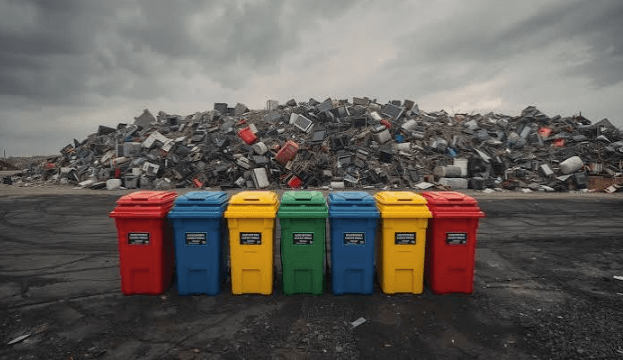
There’s a drawer in most homes and a closet in most offices holding the same thing: dead laptops, orphaned chargers, a monitor that still works but nobody wants. It sits there because throwing it out feels wrong and nobody knows the alternative.
The instinct is right. Electronic recycling isn’t just a tidier way to dispose of old kit — it’s the difference between a device becoming a hazard and becoming useful again. Here are nine reasons it’s worth the extra step.
1. Most of that equipment still works
The reflex is to assume old means broken. Usually it doesn’t. A four-year-old desktop that felt slow under one workload runs perfectly well for web browsing, homework and office documents.
Organisations like the Electronic Recycling Association exist on this premise. ERA is a non-profit that has been reducing electronic waste since 2004, repurposing equipment rather than shredding it by default. Reuse is a better environmental outcome than recycling, and it’s a better outcome for whoever receives the device.
2. Somebody nearby needs a computer right now
This is the part people underestimate. Applying for a job, completing school work, checking a bus route — all of it now assumes a computer.
ERA runs a charitable donation programme built specifically around that gap, providing refurbished equipment to local charities at no cost. Their published examples include 160 computers donated to the Calgary Bridge Foundation for Youth. Your unwanted laptop is somebody’s only laptop.
3. Lithium batteries in the bin are a genuine fire risk
This is the reason to stop treating old electronics as ordinary rubbish, and it’s not abstract.
Laptops, phones and tablets contain lithium batteries. When those batteries are damaged or crushed — in a garbage truck, in a compactor, in a landfill — they can spark fires. ERA is explicit about this: it creates safety risks for waste workers and causes environmental damage. A phone in a bin bag is a small hazard being handed to someone whose job it is to lift it.
4. The materials inside are genuinely scarce
Electronics aren’t plastic boxes. They contain rare earth elements, precious metals and alloys pulled out of the ground at real environmental cost, often in a handful of countries.
Recovery puts those materials back into circulation instead of leaving them in a hole in the ground. Every recovered kilo is a kilo nobody has to mine.
5. There are drop-off points closer than you think
The usual objection is convenience — people assume recycling old electronics means a special trip somewhere inconvenient.
ERA operates drop-off locations across North America, with US sites including Seattle, San Jose, Boston, Houston, Chicago, New York and Vermont, plus a pickup service. Finding the nearest depot is normally a two-minute job, not an afternoon.
6. Data security is handled — and that’s the actual blocker
Ask people why the old laptop is still in the cupboard and the honest answer is rarely laziness. It’s that they don’t know what’s still on the drive.
That fear is the single biggest obstacle to reuse. Reputable recyclers address it directly: ERA uses erasure software and physical hard drive shredders, and states that data security is maintained at each step from pickup through secondary use. Once you know the drive gets handled properly, the cupboard empties.
7. Businesses get a documented paper trail
For an organisation, “we recycled it” isn’t good enough. Auditors want to know which assets left, when, and what happened to the data on them.
Established providers issue documentation — collection certificates, inventory spreadsheets with make, model and serial numbers, data wipe certificates, certificates of destruction. That paperwork is what turns an IT clear-out into something you can close out cleanly at year end.
8. It costs less than most people assume
There’s a widespread belief that responsible disposal is expensive. For standard donations and pickups, it often isn’t.
Non-profit models like ERA’s are funded through refurbished equipment sales, partnerships and donations rather than by charging every donor. Larger jobs with detailed reporting requirements, physical destruction or unusual logistics can carry costs, and a good provider will tell you up front. But the default assumption that it’s costly keeps a lot of usable equipment sitting idle.
See also: Property Technology Explained
9. Landfill isn’t a neutral option
The last reason is the simplest. Doing nothing isn’t harmless; it just moves the harm somewhere you don’t see it.
Devices in landfill leach. Batteries ignite. Materials that took real environmental damage to extract get buried after one short working life. None of that happens because anyone decided it should — it happens because throwing something in a bin takes eight seconds and finding a depot takes ten minutes.
What electronic recycling actually asks of you
Not much, which is the frustrating part. A search for a nearby depot, or a form to book a pickup if you have volume.
If you’re clearing a household, gather everything including cables and chargers, and check what the provider accepts before you drive over — most take desktops, laptops, printers, peripherals, phone systems and servers, but the list varies. If you’re clearing an office, ask about serial number reporting and data destruction documentation before the truck arrives, because retrofitting that paperwork afterwards is impossible.
Electronic recycling turns a hazard into either a working computer for someone who needs one or a stream of recovered materials. The alternative turns it into a fire risk in a bin bag. That’s the whole choice.